PALAS
PALAS: from Excel to a private trade portal
Trade customers lived in Excel and every order was re-entered by hand. A private portal connected to Shopify, with no second catalogue to maintain.

Medusa agency
Articles drawn from our Medusa projects: PALAS's professional portal, B2B purchasing and AI at Scout, FN Herstal's store connected to its stock and orders. And Medusa explained, one module at a time.
Browse the articles ↗THE ARTICLES
38 articles
PALAS
Trade customers lived in Excel and every order was re-entered by hand. A private portal connected to Shopify, with no second catalogue to maintain.
Scout
Each supplier describes its products its own way; the shared catalogue has its own categories. AI suggests one, with a confidence level, for review.
FN Herstal
Operations live in Odoo, content in Prismic. Connecting both to Medusa so products, stock and orders flow, while each team keeps its own tool.
Scout
In a property organisation, not everyone buys for the same buildings. Each member’s role and scope are set from the moment they are invited.
PALAS
Card, bank transfer, or deposit then balance: each shop pays its own way. Every order now shows what has been paid and what is still due.
Scout
Purchase history answers many questions, if you know which filters to combine. Here you ask in plain words, and the answer cites the purchases.
Scout
Every supplier sends a different file, and one bad row shouldn’t sink the whole import. A flow where only the failed rows need fixing again.
Merchant agent
Traffic, ads, orders, emails: each tells part of a store’s day. An internal agent, still under construction, is learning to read them together.
FN Herstal
One catalogue in euros, another in dollars, a third in pounds? FN Herstal starts from a euro base, converted with an adjustable safety margin.
Scout
A purchase climbs several approval levels before reaching a supplier. A tiered workflow that shows who decides and keeps moving when people are away.

Scout
Every supplier has its own vocabulary. A search that understands a plain request, finds an exact reference and compares the offers you can access.
PALAS
Shop relationships were scattered across spreadsheets, email threads and trade fairs. Now the team picks up a customer file without rebuilding it.
Merchant agent
When sales drift from their usual level, the first explanation is often the wrong one. An investigation method that also names what remains unknown.
Scout
One need can involve several suppliers and several flats. The basket is split, each line allocated, then tracked until it is received.
Scout
Every supplier lays out its PDF invoice differently. Its data is extracted, matched to the order or the service, then validated by a person.
FN Herstal
Employees shop on the public store, but on their own terms: an entitlement tied to their account, a yearly cap and stacking rules.
Merchant agent
On a Black Friday launch, every tool claims a share, and the claims don’t match real orders. An investigation traces where each sale came from.
Scout
A new supplier file updates prices and stock, but can overwrite enriched product pages. Compare, choose what to keep, and limit each feed.
PALAS
A trade order arrives as a few lines on WhatsApp. AI finds the shop, the pieces and the quantities, and prepares a draft the team checks.
Scout
At a supplier, stores, sales reps and head office don’t need to see the same things. Each person gets their own portfolio, orders and alerts.
Merchant agent
A weak day sets off a hunt for a culprit: a campaign, a page, a bug. Here possible causes are ranked by the evidence behind them.
Scout
You don’t order a plumber like a box of light bulbs. AI helps draft and break down the scope of work; authorised people review and decide.
PALAS
Some shops buy to resell, others take stock on consignment; some order alone, others through the team. One trade area handles both models.
Scout
Across a property portfolio, many services recur on a schedule. A series generates the purchase orders, which can be changed, paused or skipped.
Merchant agent
A campaign can multiply clicks without bringing in buyers. Following by hand the path from spend to visits, then to the store’s actual orders.
Scout
Accounting needs to know which account, property and flat each purchase belongs to. Expenses coded, invoices checked, then a single export.
PALAS
Shipping on a trade order depends on the basket and the destination. PALAS sets its own rate table, and the shop sees its total before confirming.
Scout
A supplier has a base price and terms negotiated with some customers. Dated price lists, reserved for the properties they actually cover.
Merchant agent
An investigation yields dozens of figures; a merchant needs a clear judgement each morning. A short email review, still at the mock-up stage.

Medusa Extend
Selling to a company goes beyond a billing address: its buyers, their roles and their purchases all need a place in Medusa.
Medusa Extend
Products entrusted to shops and paid for once sold. Between sales, returns and stock gaps, what does Medusa need to track?
Medusa Extend
A sales rep dictates an order on their phone. The assistant finds the customer, variants and stock, then waits for their go-ahead before drafting it.
Medusa Extend
An AI agent runs, but what does each run cost and how good is its output? A first monitoring layer in Medusa, modelled on Langfuse.

Medusa Explained
Catalogue, prices, stock, warehouses: Medusa splits commerce into modules. What one contains, and how to build your own with the same tools.
Medusa Explained
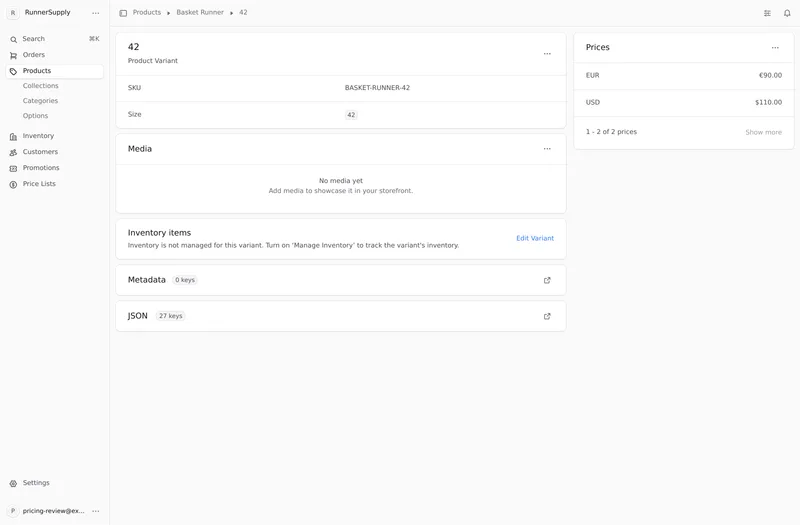
One pair of trainers, from a first euro price to a bulk rate: where Medusa stores these amounts and how it picks the right one at checkout.
Medusa Explained
Same variant, a different price in one region: how a simple context rule lets the Pricing module pick the right amount.
Medusa Explained
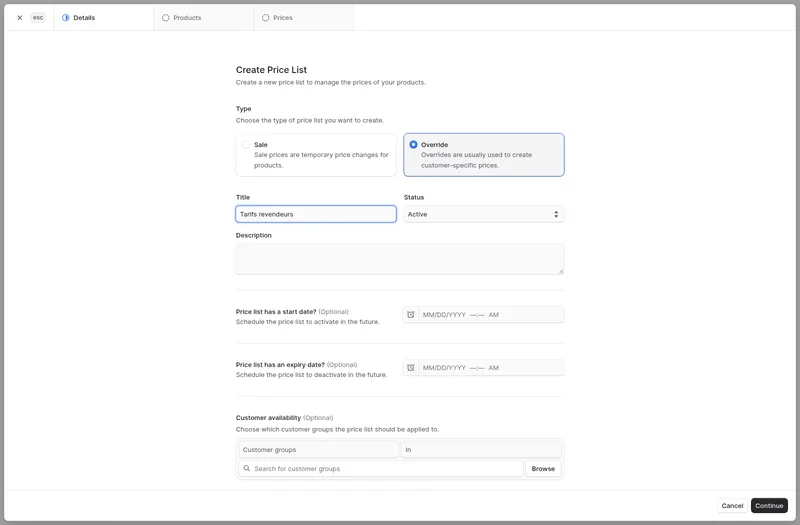
Your resellers negotiated their rates; the public keeps its own. A price list applies those amounts to the group without touching the base prices.
Medusa Explained
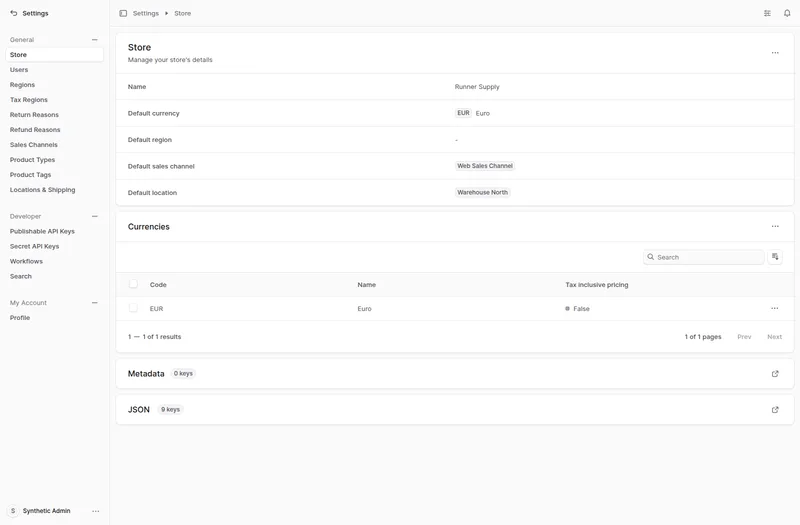
Does a stored price already include tax? Without that information, the cart gets its totals wrong. What the Pricing module records, and why.
HAVE SOMETHING IN MIND?